
Postural Orthostatic Tachycardia Syndrome
or POTS for short

What is POTS?
Postural Orthostatic Tachycardia Syndrome (POTS) is a condition that affects the autonomic nervous system — the part of the nervous system responsible for regulating many of the things our bodies do automatically.
This includes heart rate, blood pressure, digestion, temperature regulation, sweating and moving blood around the body.
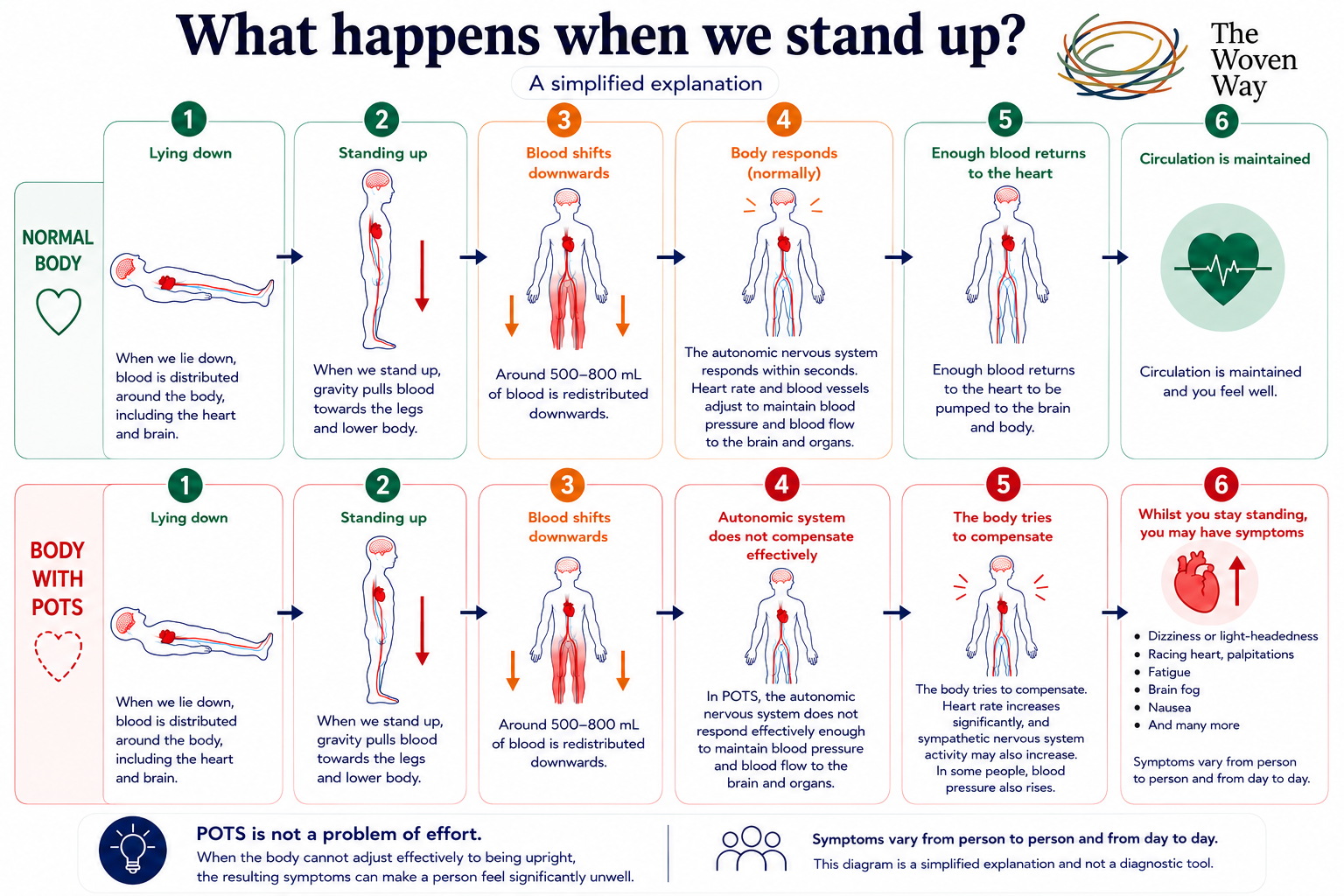
In POTS, the body has difficulty making the adjustments required when moving from lying or sitting to being upright. When someone stands, gravity causes blood to want to pool in the lower parts of the body. Normally, the autonomic nervous system makes a series of rapid adjustments to keep enough blood returning to the heart and brain.
In POTS, this process does not work effectively. The heart rate increases significantly as the body tries to compensate.
POTS is more than a fast heart rate
POTS is diagnosed partly by measuring what happens to heart rate when someone moves from lying down to standing. However, the heart rate increase is only one measurable sign of a much broader problem with autonomic regulation.
People with POTS may experience:
dizziness or light-headedness
fainting or feeling close to fainting
a racing or pounding heart
fatigue
brain fog and difficulty thinking clearly
headaches
exercise intolerance
nausea and other gastrointestinal symptoms
difficulty regulating body temperature
excessive or reduced sweating
shakiness or weakness
breathlessness
sleep difficulties
changes in symptoms after eating
difficulty standing still for long periods
Not everyone with POTS experiences the same symptoms, and symptoms can vary considerably from day to day.
Why does standing cause so many problems?
Moving from lying down to standing creates a significant challenge for the circulatory system. Around 500–800 mL of blood is redistributed from the chest into the abdomen and lower body with the change in position, reducing the amount of blood returning to the heart.
Normally, the body compensates for this almost immediately. The autonomic nervous system triggers changes in the heart and blood vessels to maintain blood pressure and keep blood circulating to the brain, while contraction of the leg muscles helps return blood towards the heart.
In POTS, these mechanisms do not compensate adequately for the change in position. Reduced return of blood to the heart means that less blood is available to be pumped with each heartbeat, and an increase in heart rate is one of the ways the body attempts to maintain circulation. Increased sympathetic nervous system activity can also contribute to symptoms such as palpitations, shakiness and sweating.
This is part of the reason POTS can produce symptoms across what may initially seem like quite different body systems. Heart rate, blood pressure, digestion, sweating and temperature regulation are all influenced by the autonomic nervous system, while changes in circulation can contribute to symptoms such as dizziness, fatigue and difficulty thinking clearly.
What causes POTS?
POTS is a syndrome rather than a single disease with one cause.
It can develop in different circumstances and may involve different mechanisms in different people. POTS may begin following an infection, surgery, pregnancy or another significant physiological stressor, although sometimes there is no obvious starting point.
There are also conditions that commonly occur alongside POTS, including hypermobile Ehlers-Danlos syndrome (hEDS) and other forms of joint hypermobility, migraine and mast cell-related conditions.
For many people, understanding these connections is an important part of making sense of symptoms that may previously have seemed unrelated.
Is it just anxiety?
POTS is a physiological condition of the autonomic nervous system. Some POTS symptoms can feel similar to anxiety. A racing heart, shaking, sweating and a surge of adrenaline are also sensations people may experience when anxious. In POTS, however, these symptoms can occur because the body is trying to maintain circulation while upright.
People with POTS can, of course, experience anxiety as well. Having a chronic illness can itself be stressful. But anxiety does not adequately explain the characteristic changes in heart rate and circulation that occur with POTS.
Why can POTS be difficult to recognise?
POTS is largely invisible. Someone may look well while their body is working extremely hard to remain upright. Symptoms may also fluctuate, and a person who can do something on one day may struggle significantly with the same activity on another.
Many individual POTS symptoms are also common in other conditions. Fatigue canbe attributed to poor sleep. A racing heart may be attributed to anxiety. Brain fog may be considered stress. Gastrointestinal symptoms may be investigated separately. When symptoms are considered one at a time, the underlying pattern can be easy to miss.
Understanding POTS often means learning how someone’s symptoms and experiences fit together.
Learning to understand your POTS
A diagnosis can be liberating, but it can also be really confusing. There can be a lot to learn, including what the autonomic nervous system does, why particular symptoms occur, what makes them worse, what your doctors are measuring, and how apparently unrelated symptoms may be connected.
It can also be difficult to find the words to explain POTS to other people.
The Woven Way offers individual POTS education sessions for people who would like time to understand their condition, connect the pieces and develop language for explaining what is happening in their body to those around them.